
We’ve already introduced you to Korean coffees here, but we’ve never yet talked about the history of coffee’s arrival in South Korea. Yes, iced coffee plays a central role in the spread of coffee.
In a country renowned for its thousand-year-old tea culture, who could have predicted that coffee would become a veritable national institution in just a few decades? Yet South Korea is now the country with the highest number of coffee shops per capita in the world. From the beverage’s introduction to the royal court in the late 19th century to the explosion of international and local franchises in the 21st century, let’s delve into the fascinating history of the spread of coffee in Korea.
Royal beginnings: coffee at the Joseon court
An aristocratic discovery
The history of coffee in Korea began in the late 19thcentury , under the Joseon dynasty. The first Korean to taste coffee is said to have been King Gojong (고종) in 1896. Antoinette Sontag, the daughter-in-law of the Russian ambassador, offered him a cup. Seduced by this exotic beverage, the king had a Western-style building, the Jeonggwanheon, built in the Deoksugung palace, where he could enjoy his daily coffee.


Coffee quickly became a popular beverage in Korean high society. The appeal of the West, in a society where ethnocultural homogeneity dominated, and the resemblance to the concoctions of Far-Eastern medicines completed the elite’s enthusiasm for this new beverage.
The birth of “dabang”: Korea’s first cafés
The first café opened in Seoul in 1902. These establishments were soon christened “dabang” (다방), a word composed of “da” (tea) and “bang” (room). Initially intended for the royal family and aristocracy, dabang saw their traditional form take hold during the period of Japanese colonization (1910-1945).
The golden age of dabang: a cultural refuge
A place for culture and exchange
From 1920 to 1960, dabang became emblematic places of Korean culture. They attracted a varied clientele: artists, intellectuals, writers and politicians gathered to discuss art, culture and politics. Many Korean literary works are written here, and cultural events such as poetry recitals and musical appreciations are organized.
The democratization of coffee
From the 1960s onwards, dabang culture opened up to a wider audience. These establishments became popular meeting places for all generations. Young people meet there for dates, while middle-aged people look for a moment of relaxation.
The rise of music dabang
In the 1970s, a new type of dabang appeared: the “music dabang”. These establishments allowed customers to choose the songs played, offering a unique musical experience at a time when access to music was limited. The DJs in these establishments became popular figures, comparable to today’s idols.
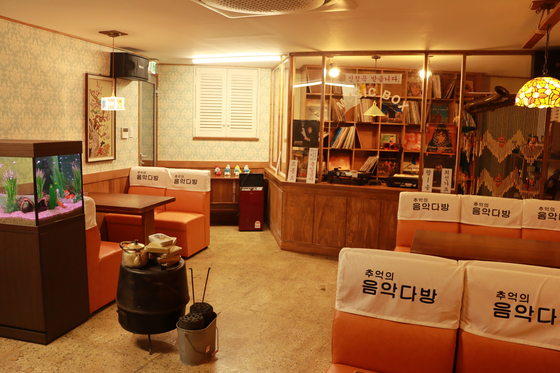
The age of instant coffee: the coffee mix revolution
American influence
The Korean War (1950-1953) marked a turning point in the history of coffee in Korea. American soldiers introduced instant coffee, which quickly became popular due to its ease of preparation and affordability.
Dabang coffee: a Korean invention
In 1976, Dongsuh Foods launched an innovative product: “dabang coffee” or “coffee mix”. These are individual sachets containing a mixture of instant coffee, sugar and cream powder. The product became a veritable phenomenon in Korea, making the country the world’s biggest consumer of instant coffee for several years.

The modern coffee revolution: the era of franchises
The arrival of international franchises
In 1999, Starbucks opened its first store in South Korea, at Ewha Women’s University. This event marked the beginning of a new era for coffee culture in the country. Koreans discovered espresso-based coffees and the takeaway coffee culture.

The rise of local franchises
Korean companies quickly jumped into the breach. Chains such as Caffe Bene, Tom N Toms and Hollys Coffee are developing and competing with foreign brands. In 2006, South Korea had 1,600 coffee shops. Today, this figure has exploded to over 66,000 establishments.
The renaissance of independent cafés
Faced with the proliferation of franchises, a new generation of independent cafés is emerging. These establishments focus on coffee quality, bean sourcing and innovative preparation methods. They attract a clientele of connoisseurs in search of unique coffee experiences.
Coffee growing in Korea today: a national passion
Record consumption
In 2019, a study by the Hyundai Research Institute revealed that average annual coffee consumption in Korea was 353 cups per person, more than double the global average. Koreans have become true coffee lovers, appreciating both the quality of the beverage and the social experience it provides.

Korean theme coffees: a Korean specialty
Korea is known for its many themed cafés, offering unique experiences to consumers. These include dog cafés, cat cafés, book cafés and cafés inspired by the world of Harry Potter. These establishments attract a younger clientele, fond of “Instagrammable” places.

Iced americano: Korea’s favourite coffee
Despite the wide variety of coffees on offer, the iced americano remains a firm favorite with Korean consumers. This preference has even given rise to the expression “eol-juk-a” (얼죽아), which literally means “an iced americano, at the risk of freezing to death”, testifying to Koreans’ passion for this drink, even in winter.
The Korean coffee industry: a booming sector
Market regulation
Faced with an explosion in the number of cafés, the Korean government attempted in 2021 to regulate the sector by imposing a minimum distance of 500 meters between two establishments. Although this law was eventually overturned, it has prompted Korea’s major chains to accelerate their international expansion.
Conquering foreign markets
Taking advantage of Korean soft power and the international craze for K-pop and Korean dramas, Korean coffee franchises have set out to conquer Asian, North American and European markets. Brands such as Caffe Bene and Tom N Toms have opened establishments in many countries, exporting a bit of Korean coffee culture around the world.
Conclusion: Coffee, the new symbol of Korean culture
In the space of a century, coffee has gone from being an exotic beverage reserved for the elite to a veritable social phenomenon in South Korea. This evolution reflects the country’s profound transformations: Westernization, rapid modernization and, more recently, cultural soft power. Today, Korean cafés, whether international franchises or independent establishments, have become emblematic landmarks of the country’s urban culture, testifying to Korean society’s capacity for adaptation and innovation.
The history of coffee in Korea is much more than a simple culinary anecdote: it reflects the social, cultural and economic evolution of a country that has managed to transform an imported beverage into a veritable art of living, recognized and appreciated the world over.


Leave a Reply